 Add to Chrome
 Add to Firefox
 Add to Edge
Dexora: Open-source VLA for High-DoF Bimanual Dexterity
May 18, 2026
Vision-Language-Action (VLA) models have recently become a central direction in embodied AI, but current systems are restricted to either dual-gripper control or single-arm dexterous hand manipulation. While low-dimensional gripper control can often be handled with simpler methods, high-dimensional dexterous hand control benefits greatly from full end-to-end VLA learning. In this work, we introduce Dexora, the first open-source VLA system that natively targets dual-arm, dual-hand high-DoF manipulation. We design a hybrid teleoperation pipeline that decouples gross arm kinematics (captured with a custom exoskeleton backpack) from fine finger motion (markerless hand tracking via Apple Vision Pro), and that drives both a physical dual-arm dual-hand platform and an identical MuJoCo digital twin. Using that interface, we assemble a large training corpus: an embodiment-matched synthetic corpus (100K simulated trajectories, 6.5M frames) and a real-world dataset of 10K teleoperated episodes (2.92M frames). To mitigate noisy teleoperation demonstrations, we propose a data-quality-aware training recipe: an offline discriminator provides clip-level weights for diffusion-transformer policy training, down-weighting low-quality demonstrations. Empirically, Dexora outperforms competitive VLA baselines on both basic and dexterous benchmarks (e.g., average dexterous success 66.7% vs. 51.7%), attains 90% success on basic tasks, and shows robust out-of-distribution and cross-embodiment generalization. Ablations confirm the importance of real data and the discriminator for dexterity.

Toward Visually Realistic Simulation: A Benchmark for Evaluating Robot Manipulation in Simulation
May 07, 2026Reliable simulation evaluation of robot manipulation policies serves as a high-fidelity proxy for real-world performance. Although existing benchmarks cover a wide range of task categories, they lack visual realism, creating a large domain gap between simulation and reality. This undermines the reliability of simulation-based evaluation in predicting real-world performance. To mitigate the sim-to-real visual gap, we conduct a systematic analysis to isolate the effects of lighting and material. Our results show that these factors play a critical role in geometric reasoning and spatial grounding, yet are largely overlooked in existing benchmarks. Motivated by the analysis, we propose VISER, a visually realistic benchmark for evaluating robot manipulation in simulation. VISER features a high-fidelity dataset of over 1,000 3D assets with physically-based rendering (PBR) materials, along with 3D scenes created from these assets through curated layouts or generation. To this end, we propose an automated pipeline leveraging Multi-modal Large Language Models (MLLMs) for material-aware part segmentation and material retrieval, enabling scalable generation of physically plausible assets. Building on the high-fidelity 3D asset dataset, we construct diverse evaluation tasks, such as grasping, placing, and long-horizon tasks, enabling scalable and reproducible assessment of Vision-Language-Action (VLA) models. Our benchmark shows a strong correlation between simulation and real-world performance, achieving an average Pearson correlation coefficient of 0.92 across different policies.
R3D: Revisiting 3D Policy Learning
Apr 16, 20263D policy learning promises superior generalization and cross-embodiment transfer, but progress has been hindered by training instabilities and severe overfitting, precluding the adoption of powerful 3D perception models. In this work, we systematically diagnose these failures, identifying the omission of 3D data augmentation and the adverse effects of Batch Normalization as primary causes. We propose a new architecture coupling a scalable transformer-based 3D encoder with a diffusion decoder, engineered specifically for stability at scale and designed to leverage large-scale pre-training. Our approach significantly outperforms state-of-the-art 3D baselines on challenging manipulation benchmarks, establishing a new and robust foundation for scalable 3D imitation learning. Project Page: https://r3d-policy.github.io/
PARSE: Part-Aware Relational Spatial Modeling
Mar 08, 2026Inter-object relations underpin spatial intelligence, yet existing representations -- linguistic prepositions or object-level scene graphs -- are too coarse to specify which regions actually support, contain, or contact one another, leading to ambiguous and physically inconsistent layouts. To address these ambiguities, a part-level formulation is needed; therefore, we introduce PARSE, a framework that explicitly models how object parts interact to determine feasible and spatially grounded scene configurations. PARSE centers on the Part-centric Assembly Graph (PAG), which encodes geometric relations between specific object parts, and a Part-Aware Spatial Configuration Solver that converts these relations into geometric constraints to assemble collision-free, physically valid scenes. Using PARSE, we build PARSE-10K, a dataset of 10,000 3D indoor scenes constructed from real-image layout priors and a curated part-annotated shape database, each with dense contact structures and a part-level contact graph. With this structured, spatially grounded supervision, fine-tuning Qwen3-VL on PARSE-10K yields stronger object-level layout reasoning and more accurate part-level relation understanding; furthermore, leveraging PAGs as structural priors in 3D generation models leads to scenes with substantially improved physical realism and structural complexity. Together, these results show that PARSE significantly advances geometry-grounded spatial reasoning and supports the generation of physically consistent 3D scenes.
ArtLLM: Generating Articulated Assets via 3D LLM
Mar 01, 2026Creating interactive digital environments for gaming, robotics, and simulation relies on articulated 3D objects whose functionality emerges from their part geometry and kinematic structure. However, existing approaches remain fundamentally limited: optimization-based reconstruction methods require slow, per-object joint fitting and typically handle only simple, single-joint objects, while retrieval-based methods assemble parts from a fixed library, leading to repetitive geometry and poor generalization. To address these challenges, we introduce ArtLLM, a novel framework for generating high-quality articulated assets directly from complete 3D meshes. At its core is a 3D multimodal large language model trained on a large-scale articulation dataset curated from both existing articulation datasets and procedurally generated objects. Unlike prior work, ArtLLM autoregressively predicts a variable number of parts and joints, inferring their kinematic structure in a unified manner from the object's point cloud. This articulation-aware layout then conditions a 3D generative model to synthesize high-fidelity part geometries. Experiments on the PartNet-Mobility dataset show that ArtLLM significantly outperforms state-of-the-art methods in both part layout accuracy and joint prediction, while generalizing robustly to real-world objects. Finally, we demonstrate its utility in constructing digital twins, highlighting its potential for scalable robot learning.
XDen-1K: A Density Field Dataset of Real-World Objects
Dec 11, 2025A deep understanding of the physical world is a central goal for embodied AI and realistic simulation. While current models excel at capturing an object's surface geometry and appearance, they largely neglect its internal physical properties. This omission is critical, as properties like volumetric density are fundamental for predicting an object's center of mass, stability, and interaction dynamics in applications ranging from robotic manipulation to physical simulation. The primary bottleneck has been the absence of large-scale, real-world data. To bridge this gap, we introduce XDen-1K, the first large-scale, multi-modal dataset designed for real-world physical property estimation, with a particular focus on volumetric density. The core of this dataset consists of 1,000 real-world objects across 148 categories, for which we provide comprehensive multi-modal data, including a high-resolution 3D geometric model with part-level annotations and a corresponding set of real-world biplanar X-ray scans. Building upon this data, we introduce a novel optimization framework that recovers a high-fidelity volumetric density field of each object from its sparse X-ray views. To demonstrate its practical value, we add X-ray images as a conditioning signal to an existing segmentation network and perform volumetric segmentation. Furthermore, we conduct experiments on downstream robotics tasks. The results show that leveraging the dataset can effectively improve the accuracy of center-of-mass estimation and the success rate of robotic manipulation. We believe XDen-1K will serve as a foundational resource and a challenging new benchmark, catalyzing future research in physically grounded visual inference and embodied AI.
Embodied Tree of Thoughts: Deliberate Manipulation Planning with Embodied World Model
Dec 09, 2025World models have emerged as a pivotal component in robot manipulation planning, enabling agents to predict future environmental states and reason about the consequences of actions before execution. While video-generation models are increasingly adopted, they often lack rigorous physical grounding, leading to hallucinations and a failure to maintain consistency in long-horizon physical constraints. To address these limitations, we propose Embodied Tree of Thoughts (EToT), a novel Real2Sim2Real planning framework that leverages a physics-based interactive digital twin as an embodied world model. EToT formulates manipulation planning as a tree search expanded through two synergistic mechanisms: (1) Priori Branching, which generates diverse candidate execution paths based on semantic and spatial analysis; and (2) Reflective Branching, which utilizes VLMs to diagnose execution failures within the simulator and iteratively refine the planning tree with corrective actions. By grounding high-level reasoning in a physics simulator, our framework ensures that generated plans adhere to rigid-body dynamics and collision constraints. We validate EToT on a suite of short- and long-horizon manipulation tasks, where it consistently outperforms baselines by effectively predicting physical dynamics and adapting to potential failures. Website at https://embodied-tree-of-thoughts.github.io .
One Policy but Many Worlds: A Scalable Unified Policy for Versatile Humanoid Locomotion
May 24, 2025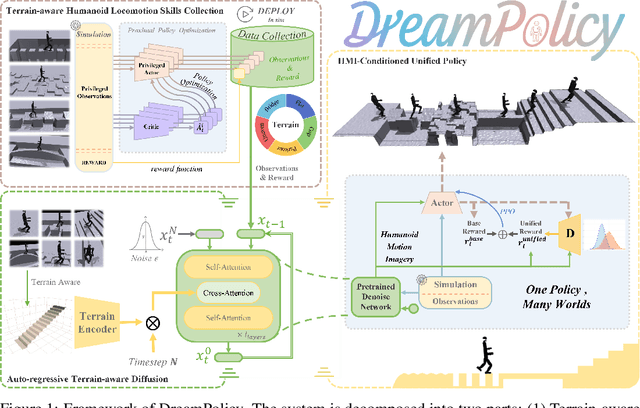
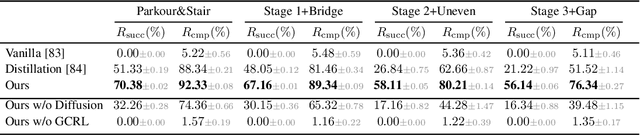
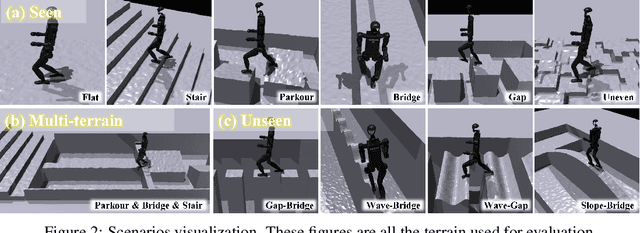
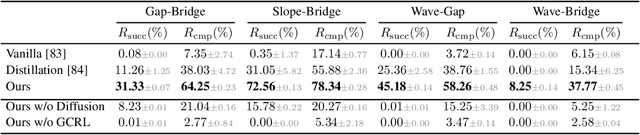
Humanoid locomotion faces a critical scalability challenge: traditional reinforcement learning (RL) methods require task-specific rewards and struggle to leverage growing datasets, even as more training terrains are introduced. We propose DreamPolicy, a unified framework that enables a single policy to master diverse terrains and generalize zero-shot to unseen scenarios by systematically integrating offline data and diffusion-driven motion synthesis. At its core, DreamPolicy introduces Humanoid Motion Imagery (HMI) - future state predictions synthesized through an autoregressive terrain-aware diffusion planner curated by aggregating rollouts from specialized policies across various distinct terrains. Unlike human motion datasets requiring laborious retargeting, our data directly captures humanoid kinematics, enabling the diffusion planner to synthesize "dreamed" trajectories that encode terrain-specific physical constraints. These trajectories act as dynamic objectives for our HMI-conditioned policy, bypassing manual reward engineering and enabling cross-terrain generalization. DreamPolicy addresses the scalability limitations of prior methods: while traditional RL fails to exploit growing datasets, our framework scales seamlessly with more offline data. As the dataset expands, the diffusion prior learns richer locomotion skills, which the policy leverages to master new terrains without retraining. Experiments demonstrate that DreamPolicy achieves average 90% success rates in training environments and an average of 20% higher success on unseen terrains than the prevalent method. It also generalizes to perturbed and composite scenarios where prior approaches collapse. By unifying offline data, diffusion-based trajectory synthesis, and policy optimization, DreamPolicy overcomes the "one task, one policy" bottleneck, establishing a paradigm for scalable, data-driven humanoid control.
ExFace: Expressive Facial Control for Humanoid Robots with Diffusion Transformers and Bootstrap Training
Apr 20, 2025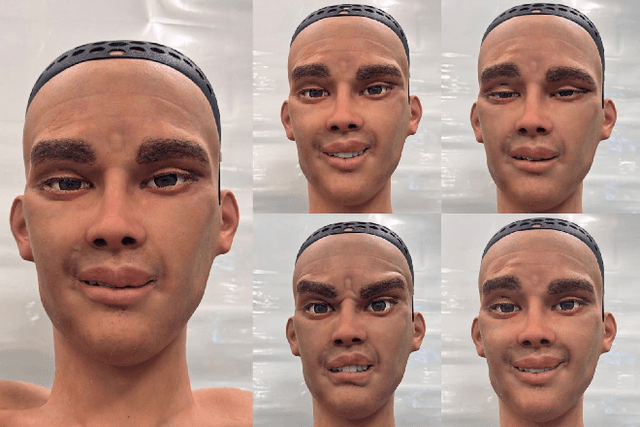
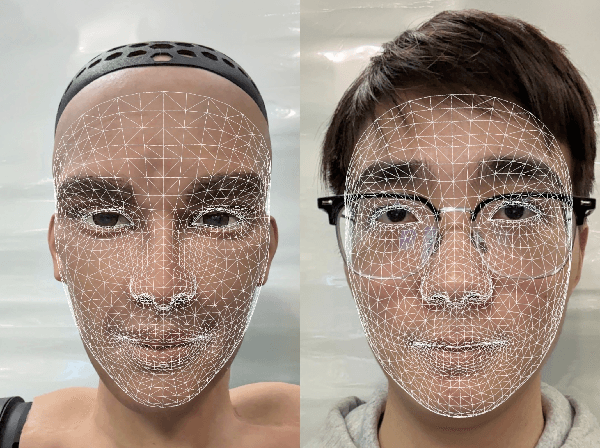
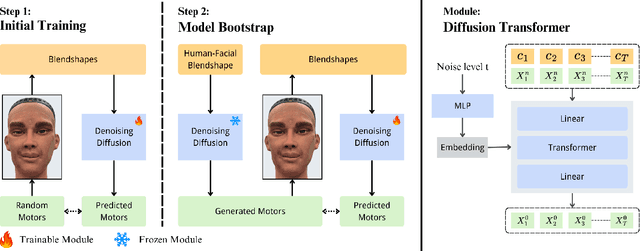
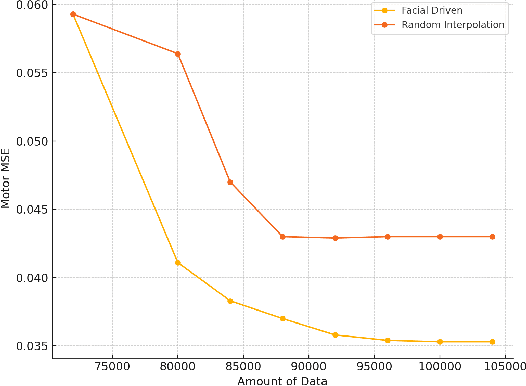
This paper presents a novel Expressive Facial Control (ExFace) method based on Diffusion Transformers, which achieves precise mapping from human facial blendshapes to bionic robot motor control. By incorporating an innovative model bootstrap training strategy, our approach not only generates high-quality facial expressions but also significantly improves accuracy and smoothness. Experimental results demonstrate that the proposed method outperforms previous methods in terms of accuracy, frame per second (FPS), and response time. Furthermore, we develop the ExFace dataset driven by human facial data. ExFace shows excellent real-time performance and natural expression rendering in applications such as robot performances and human-robot interactions, offering a new solution for bionic robot interaction.
CAST: Component-Aligned 3D Scene Reconstruction from an RGB Image
Feb 18, 2025Recovering high-quality 3D scenes from a single RGB image is a challenging task in computer graphics. Current methods often struggle with domain-specific limitations or low-quality object generation. To address these, we propose CAST (Component-Aligned 3D Scene Reconstruction from a Single RGB Image), a novel method for 3D scene reconstruction and recovery. CAST starts by extracting object-level 2D segmentation and relative depth information from the input image, followed by using a GPT-based model to analyze inter-object spatial relationships. This enables the understanding of how objects relate to each other within the scene, ensuring more coherent reconstruction. CAST then employs an occlusion-aware large-scale 3D generation model to independently generate each object's full geometry, using MAE and point cloud conditioning to mitigate the effects of occlusions and partial object information, ensuring accurate alignment with the source image's geometry and texture. To align each object with the scene, the alignment generation model computes the necessary transformations, allowing the generated meshes to be accurately placed and integrated into the scene's point cloud. Finally, CAST incorporates a physics-aware correction step that leverages a fine-grained relation graph to generate a constraint graph. This graph guides the optimization of object poses, ensuring physical consistency and spatial coherence. By utilizing Signed Distance Fields (SDF), the model effectively addresses issues such as occlusions, object penetration, and floating objects, ensuring that the generated scene accurately reflects real-world physical interactions. CAST can be leveraged in robotics, enabling efficient real-to-simulation workflows and providing realistic, scalable simulation environments for robotic systems.